What a running gait analysis actually looks at
It's more than a video of you on a treadmill. Here's what our running biomechanical analysis includes, who it's for, and what you walk away with.

Runners tend to arrive with one of two stories. Either something hurts every time they run and they're tired of guessing, or nothing hurts yet and they want to get faster without breaking. Our running biomechanical analysis is built for both.
Here's what it actually involves — because "gait analysis" gets used loosely, and we'd like you to know what you're getting.
Two parts: video gait analysis and strength testing
The analysis has two halves, and we think both matter.
Video gait analysis. We record you running and slow it down, so we can see what happens in the moments that are impossible to catch with the naked eye — how you land, how your hips and knees track, what your trunk and arms are doing, where things break down as you fatigue. You'll see the footage with us. Most runners have never watched themselves this closely, and it tends to be a light-bulb moment.
Strength testing. This is the half that often gets skipped elsewhere. What shows up on video usually has a reason behind it, and that reason is often something the muscles can or can't do. Testing that directly tells us whether what we saw is a habit, a strength issue, or a mobility issue — and that changes what we do about it.
Who it's for
- Runners with pain. If a knee, hip, foot, or back complaint shows up when you run, the analysis is how we find the cause instead of chasing the symptom. Fixing what's driving the pain is the goal.
- Runners who want more pace. You don't have to be hurt to benefit. Understanding what your stride is costing you is a starting point for running more efficiently.
- Runners coming back. After time off, an analysis is a sensible way to see where you actually are before you ramp up.
We've worked with people at every level, from someone training for a first race to professional athletes. One of our patients put it this way: "Despite an injury, I crossed the finish line on my first marathon." That's the kind of outcome we care about.
What you walk away with
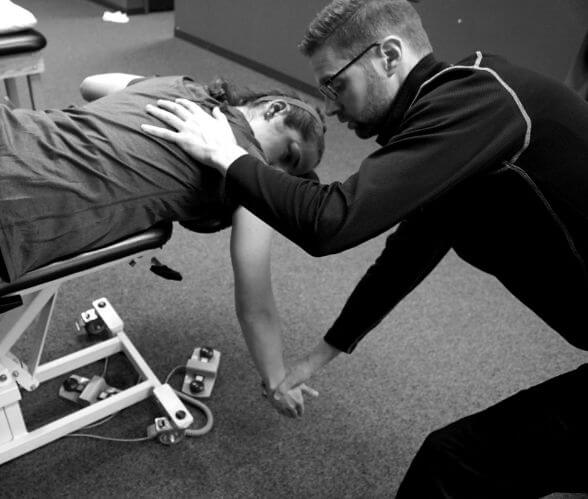
You leave understanding what we saw, why it matters, and what we'd change — and it's a conversation, not a printout. Because the analysis is done by a Doctor of Physical Therapy, one-on-one, the plan that comes out of it can go straight into hands-on treatment or into structured strength work with our NASM-certified, doctorate-level staff, depending on what you need. Nothing gets lost in a handoff, because there isn't one.
Why we do it this way
Our whole model is one clinician, one patient, one full session. That's true for the running analysis just like it's true for everything else here. We'd rather spend the time to get the cause right and see you improve quickly than book you for a long series of visits that never quite get to it.
Ready to find out what your stride is doing?
You don't need a referral to start physical therapy in Michigan, so the first step is simply to reach out. Text us a little about your running — what's bothering you, or what you're training for — and we'll tell you honestly whether the analysis is the right next step. We're in Plymouth at 41100 Plymouth Rd, Suite B1-162, by appointment, and a second location is opening soon.